Monday, June 6, 2016
To be Or Not to be

Sunday, May 15, 2016
Will Market Optimism survive time..?
It has been string of Bad news in various fronts that have played like unharmonized discourse from Wednesday April 12th 2016.
1) Banking Results showing ' Charred Balance Sheets'
2) Canadian Fire and Fall UAE Oil production supported and Confirmed Crude to remain above $45 for Longish time.
3) U.S Consumer shifted from ' Mall Culture' with Macey, Groupon, like big retailers losing ground and Margin. While Apple showing no promises dragging below $90. While Donald Trump continues with weird but Populist talk and blowing lungs on amazon. The chance of FED raising rates in June have Increasing. S&P reached 945 effortlessly.
4) Indian Government rose from Slumber and announced Revision in Mauritius Treaty and announcements of Capital Gains on FII and PNote. Well, followed by SEBI targeting PNote. With Macho Swamy calling for removal of Dr. Rajan for keeping interest rates high, shivering Reason. The Bankruptcy Code Bill awaiting ended with doubt of implementation.
5) The weekend started with Bank of Baroda disappointment. IMF showing ' Slowing Funds' towards emerging economies. With Saturday, evening Slowing China Growth was re-sound.
6) Indian MET announcement of delayed Monsoon shall create Doubts.
. Finally, as Tamilnad goes to poll on 16th the State Election exit polls shall be available at about 6.00 PM.
Can they point for any respite..?
But, Foreign investors with no returns for an year will survive the time for revival?
Saturday, May 14, 2016
Will Dr Rajan shall Survive Swamy?
Dr Rajan RBI's. Governor ending Term in September 2016.
It has been a speculation about Dr. Rajan's straight forwardness and intelligence against Dr. Subramanyam Swamy's coy. With Indian ruling party having not anointed Dr. Rajan, he appeared ' External' and Tolerated Eye Soar, for last 2 years.
Dr Swamy, who Senior BJP Leader has stirred Indians with statement against Dr Rajan. His venting hot air show disgruntled elements in ruling party, demanding Pound of Flesh.
Whether, his call is backed by F. M. and big houses like whose entry in Indian banking is blocked and many PSU banker and Industrial houses whose accounts are in public glare..?
Thursday, June 4, 2015
Wednesday, May 14, 2014
The Exit Polls for Book Out Profits before Vanish.

Its time that, Investor should not become Greedy but fearful of the out come of the Adverse Election Results, Which are hyped up so much in one direction, that smallest of the disappointment shall put the whole Edifice of the market to ground like a straws in the wind.
But, the fear and greed always run the market.
The Best way to deal is controlling greed and Booking Profit..!
Friday, August 17, 2012
Will Equities continue the March to year end
While, Commodities and particularly Oil has fully recovered the ' Paralysis ' Much faster than thought by any one. Gold and Silver not falling in sympathy, While ' Equities' running ' blind Fold' action. The USD still remains a suspect. And, lastly bonds in US and Europe are ' dead wood'
Indian markets struggling from the brink and remains as suspect.
Will this ' contrariness ' sustain itself..? Many think Yes and more think and lurk on the background to enter.
However, the discipline investor should wait for the last episode of this Play and keep waiting for the next day till .. Markets scale a new peak. Markets are going up for end of ' selling ' season in June and likely to test the virtue of being patient But, the upcoming FOMC meeting shall be the end of the ' Game of Waiting' and shall be the decider.

Friday, March 2, 2012
Wednesday, February 22, 2012
Stock Sweetness and bitter pill

Unlike, in 70s to early this century commodities hardly tracked and coyed the equities. But, with the continuous Money injections and abetting by the US FED the co relation seems to be getting entrenched and creating trading pattern. The Equity-commodity unison seems to be obvious and reasonable and most importantly acting as proxies for various currencies like Canadian $, US $, Euro and lately developing world and special reference to Asian Currencies. The Cocktail tastes good and healthy now, and it seems the indicators have started showing divergences and likely to break sooner than ever. The Early indicator seems to be Gold..
Next question lies Who will loose and break the tempo and momentum...?
Monday, January 23, 2012
Reserve Bank of India's Monetary Review - 2011-12
| |||||

Friday, January 20, 2012
Reliance Industries Press Release

Reliance Press Release is shared here for the Investor's to see themselves the most valuable Indian Company. It seems that Mr Mukesh Ambani has taken keen interest in many other sectors like 4G, retails, infra development and so on.
It is unfortunate that Reliance Industry has kept itself moving away from Oil and Gas Exploration and Refining sector. Absurd, as Mr Ambani is himself An expert Engineer but the Hostile Governmental Policies possibly have put the breaks on this sector.
Indian Government cashes on Gold Rush
Mr Yashwant Sinha then finance Minister lowered the custom duty on Gold. 2001-2002:"In order to discourage smuggling I propose to reduce the duty on gold from Rs 400 per 10 grams to Rs 250 per 10 grams."- Yashwant Sinha.
Well, then Gold was trading at much Lower Price @ $ 300 per Ounce and RS 6000 about in Indian Currency .
Saturday, January 14, 2012
Greece Debt affairs are stinking. Default to be timed..?
Press Statement from the Co-Chairmen of the Steering Committee of the Private Creditor-Investor Committee for Greec

Tuesday, January 10, 2012
Will politicians make common breath..? explains Neel Kashkari

- Debating a future of inflation vs. deflation is radically new territory for investors. The chaotic nature of the choice facing societies is whipsawing equity markets and dominating bottom-up factors.
- Equity investors seem to be pricing in a combination of outcomes, with the largest weighting going to a goldilocks, mild inflation scenario. But the market’s large daily swings reflect jumps back and forth as investors update the probabilities of very different destinations.
This is a debate that has raged within PIMCO for quite a while. There is a wide range of opinions, each supported by relevant precedents and sound economic reasoning. Yet despite our intense focus, we don’t know the answer with certainty.
Here in America we too face a similar question, though markets are not currently demanding an immediate answer. For the last few decades America has fueled its economic growth by borrowing and consuming, and, in doing so, has racked up large, unsustainable debt. Families that take on too much debt must eventually cut spending, either to pay back loans, or at least because banks stop lending them money. They are eventually forced into some combination of austerity and default. But countries with their own currencies have a choice: 1) austerity-induced deflation, or 2) print money and eventually trigger inflation, which makes their debts easier to pay off, while robbing creditors of the real return they were promised. Will we find the political will to cut spending? Or will we continue running large deficits? Will the Federal Reserve resume quantitative easing, in effect monetizing our debts? Will it unintentionally trigger inflation?
Listening to my colleagues make their arguments during the Forum, I was taken back to my days fifteen years ago when I was an engineering graduate student at the University of Illinois. You may wonder what a debate about the global economy has to do with engineering. It reminded me of one of my favorite classes: nonlinear systems – the study of natural and man-made systems that, at times, behave very oddly. Allow me to explain.
Most systems we interact with every day are linear: if you change an input to the system by a small amount, the output will also change by a small amount. Think about driving to work: if you leave your house 10 minutes early, you will usually arrive about 10 minutes early. If you turn up the flame on a stove a little, the pot of water will heat a little faster.
But some systems, under certain conditions, behave very differently. These systems are said to have “sensitive dependence on initial conditions” – very small changes of the inputs can lead to enormous variations of the output. Mathematicians have given these systems the label of being “chaotic” and experts in the field are called “chaoticians.” (The term “chaotician” always struck me as ridiculous. Could you imagine introducing yourself this way?) The weather is the best example of a real-life chaotic system. Predicting the weather beyond a few days is impossible because minor variations lead to large changes in the future. Go back to the driving example: if you leave 10 minutes late, rather than 10 minutes early, you might hit rush hour, and the extra 10 minutes ends up costing you an hour. Chaos theory describes the conditions under which a system changes from linear and smooth to highly nonlinear and violent, where minor changes to the inputs will lead to enormous variations of the output.
Western societies are facing a seemingly minor choice, but that choice will lead to vastly different endpoints for the global economy and for asset prices.
In a “normal” economic environment investors debate a narrow range of outcomes: will the U.S. grow by 2.8% or 3.2%? Will inflation remain at 2.0% or climb to 2.3%? Debating a future of inflation vs. deflation is radically new territory for investors. The chaotic nature of the choice facing societies is whipsawing equity markets and dominating bottom-up factors.
While we don’t know with certainty which path societies will choose, we can identify a few potential outcomes and make reasoned assessments of what they mean for the economy and for equities:
1. Austerity and deflation
2. Explicit default
The scenario of governments not paying back their creditors is extremely unlikely for countries that have their own currencies. Why default on your debt, which would trigger a crisis of confidence in your economy, when you can simply print more money? Of course, unpredictable politics can make the unthinkable possible, as we came dangerously close to seeing this summer with Washington’s debt ceiling debacle. In Europe it is likely some smaller countries, such as Greece, will default on their debt. They simply have taken on more debt than their economies can reasonably hope to pay back. And they don’t have their own currency, so printing drachma is not an option. It is hard to imagine a scenario where an explicit default would be good for equities. Just how bad depends on the size of the country defaulting and the extent of the preparations put in place to minimize the damage. For example, if countries have capitalized their banks to withstand the losses from a Greek default and the ECB funds Italy and Spain so they are not at risk of contagion, the impact to equities should be more muted. An uncontrolled default, or a default of a larger country would be very bad for risk assets and could trigger a deflationary spiral described above.
3. Mild inflation
Mild inflation is the goldilocks scenario: central banks print money to help fund governments while they employ structural reforms to make their economies more competitive and generate long-term growth. Such structural reforms take time to produce results, often many years. Printing money provides governments with that time while, in theory, reducing the sacrifices citizens must make, and the inflation that usually follows makes the fixed debt stock easier to service, because prices (and hence taxes) increase. It often results in a falling currency, which makes exports more competitive. It is easy to see why countries with their own currencies usually choose inflation as the preferred response to overwhelming debt. Although creditors suffer because the purchasing power they were expecting has been reduced, society has to make fewer hard choices and can continue to enjoy its exaggerated standard of living until the pro-growth economic reforms come to the rescue. In a scenario of mild inflation, equities should do well. Prices are contained, the economy functions and corporate profits should continue increasing. Of course, if policymakers do not use this time to implement real economic reforms, which can still be painful for certain constituencies, mild inflation doesn’t solve anything. It just delays the necessary day of reckoning.
4. Runaway inflation
The danger of mild inflation is that it may not remain mild. Inflation is driven by expectations, the collective beliefs of what the future holds that reside in the minds of millions of people. If people expect prices to go up, they will demand higher wages so they can maintain their standard of living. This will increase the cost of labor, pushing the cost of goods higher. A vicious cycle of inflation can take hold as prices climb higher and higher. The U.S. suffered from double-digit inflation in the 1970s, and in an extreme case, Germany suffered from hyper-inflation following World War I. Runaway inflation is devastating because an economy loses its anchor. People are afraid to hold cash because their purchasing power drops rapidly and so they must hoard real assets. Interest rates soar causing investments to plummet. Central bankers are generally afraid of attempting to induce mild inflation for fear they may nudge expectations more than they hoped. Nudging the collective beliefs of millions of people is an inexact science. The Federal Reserve is cautiously experimenting with its expectations-nudging-arsenal with its recent communication innovations. Runaway inflation would be very bad for most risk assets and equities in particular because of the devastating affects on real economic growth and the increases in costs of production and of capital. A loss of faith in paper currencies would mean gold and real assets would likely be king.
5. Miraculous growth
A list of potential solutions to our unsustainable debt load would be incomplete without including a high growth scenario. It is true there could be a major breakthrough in, for example, energy technology that spurs extraordinary economic growth, which would drive tax revenues higher and enable governments to pay down their debt without asking their citizens to give up their exaggerated living standards. In such a scenario, equity returns would likely be very strong, especially for the sector enjoying the innovation. The technology sector in the 1990s was an example. However, such a scenario today is low-probability. We invest based on what we think is likely to happen, rather than what we would like to happen. Policymakers can’t count on a growth miracle and neither can investors. And don’t forget the bumper tax revenues of the 1990s actually led to increased government spending in some cases when politicians wrongly assumed the increased tax revenues would last forever.
While the expected value of two equally possible outcomes, 0 and 1, is 0.5, there is zero chance the outcome will actually be 0.5. It will either be 0 or 1. Based on the level of the stock market today, with a price to earnings ratio of about 13x in the developed world and 11x in the emerging economies, equity investors seem to be pricing in a combination of these outcomes, with the largest weighting going to the goldilocks, mild inflation scenario. But the market’s large daily swings reflect jumps back and forth as investors update the probabilities of these very different destinations.
I believe societies will in the end choose inflation because it is the less painful option for the largest number of its citizens. I am hopeful central banks will be effective in preventing runaway inflation. But it is going to be a long, bumpy journey until the destination becomes clear. This equity market is best for long-term investors who can withstand extended volatility. Day traders beware: chaos is here to stay for the foreseeable future.
Monday, January 9, 2012
Mutual Fund fundas for all
The Mutual fund basics are not only theory but its real edge for investors who want to build there portfolio alongwith the various cycles in economic activities and investment gyrations.
Friday, January 6, 2012
Economic Developments, Risks to the Outlook, and Housing Market Policies :Governor Elizabeth A. Duke
Economic Developments, Risks to the Outlook, and Housing Market Policies
Following the sharp downturn in 2008 and the first half of 2009, real economic activity has now been expanding for more than two years (chart 1).
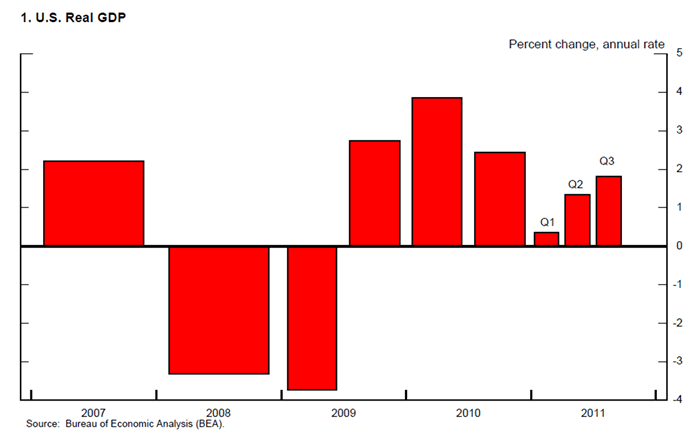
 However, the recovery has not been as strong as might have been expected given the steepness of the contraction. Early last year it threatened to stall out altogether. To be sure, economic growth in the first half of last year was depressed by some transitory factors, including high energy prices and the effects of the tragic earthquake in Japan on the production of motor vehicles. Still, even as these influences on the economy waned over the second half of 2011, economic activity appears to have increased at only a moderate pace.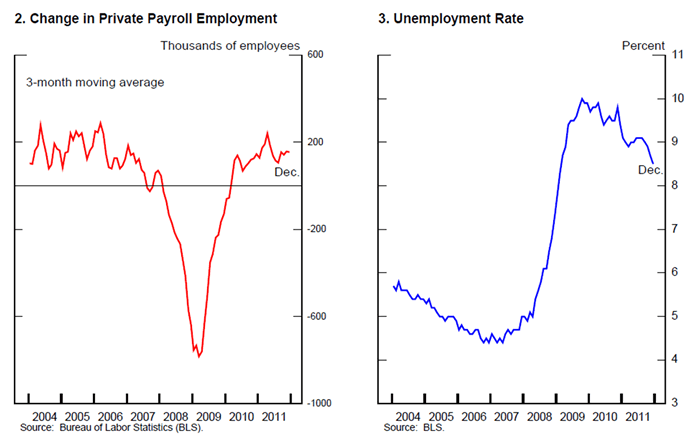
 In recent months, there have been glimmers of hope seen in the job market. For example, payroll employment rose 200,000 in December and the unemployment rate, which had hovered around 9 percent for most of the year, fell to 8.5 percent, a rate that while still far too high was the lowest in 2-1/2 years (chart 3). That said, other economic data have improved more modestly, and the bulk of the evidence, including help-wanted advertising and surveys of employers' hiring plans, suggests that the job market is not poised for marked improvement in the months ahead. Indeed, my own expectation is that while the trend in unemployment will be gradually lower, the path to get there might be choppy.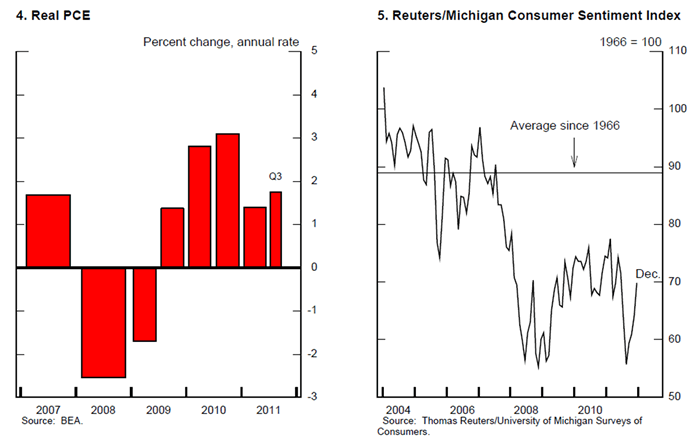
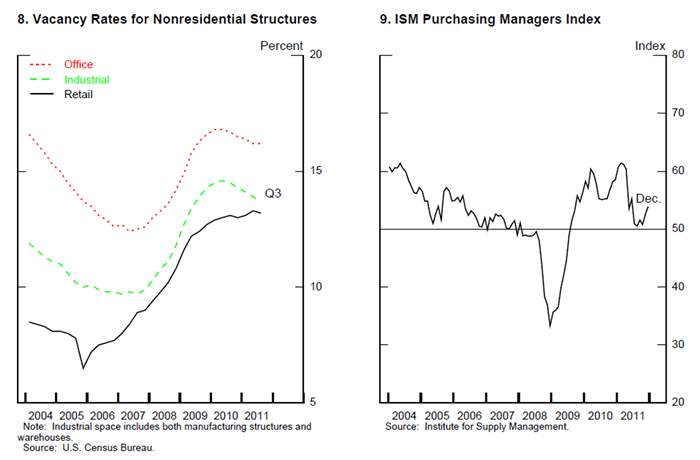

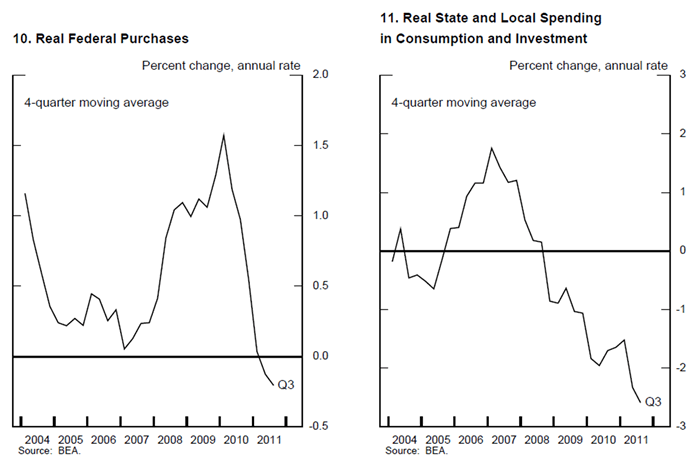
 The declines in state and local government expenditures reflect continuing cutbacks in both employment and construction outlays. The budgets of these governments are quite strained by the ongoing phase-out of federal stimulus grants and the weakness of local tax collections.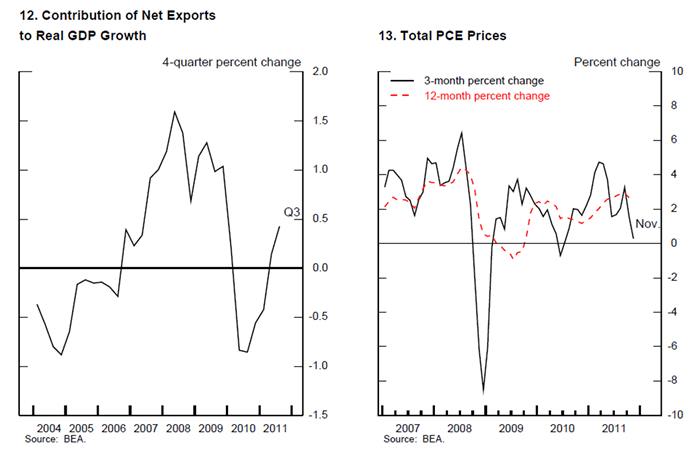
 This welcome news likely reflects the waning of the effects of the large run-ups in the prices of crude oil and other commodities early last year as well as some reversal of the increase in motor vehicle prices that followed the earthquake-related supply disruptions last spring.
Looking forward, my baseline forecast is for economic activity to gradually pick up steam over the next year or so. I recognize that some of the factors holding back the pace of activity are likely to persist. For example, with sluggish employment growth, household income may not be strong enough to support sustained increases in consumer spending. Government spending will likely continue to be a drag on economic growth going forward. Under current federal law and most projected outcomes of congressional budget negotiations, some ongoing fiscal restraint seems probable at the federal level. Moreover, state and local budgets are likely to remain under severe pressure for some time, leading these jurisdictions to continue to scale back spending. And, as I said earlier, a weak forecast for global growth indicates that net exports may provide less support to the U.S. recovery going forward.
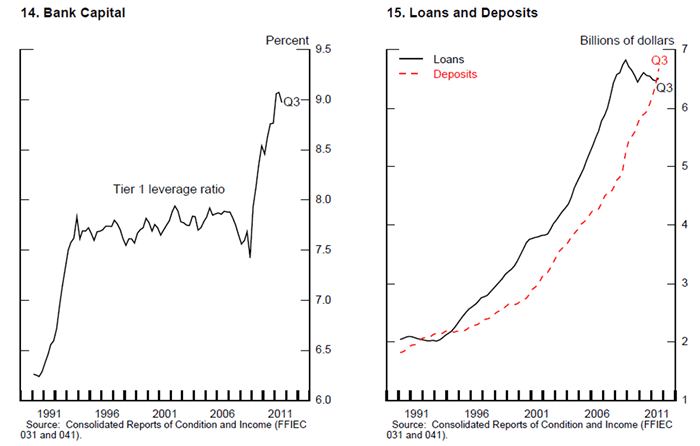
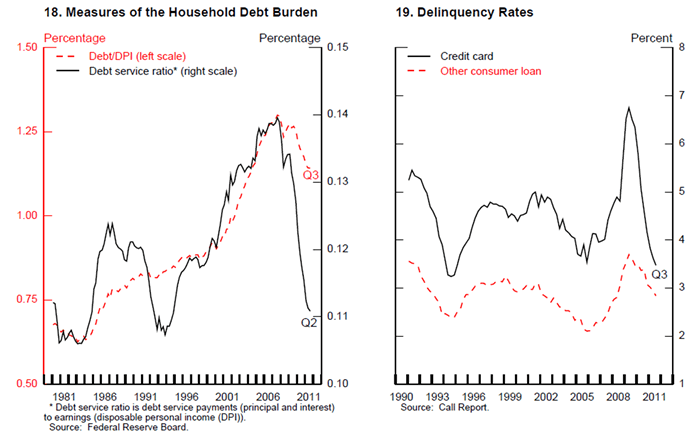
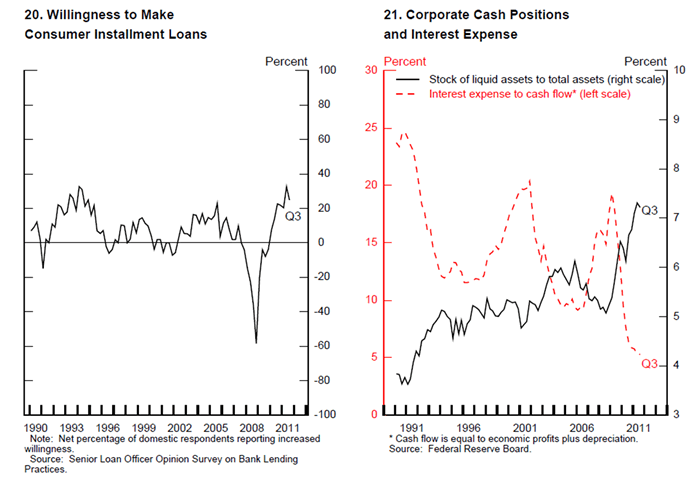
 And, although loan balances have increased in recent months, they remain well below their peak levels, leaving banks with substantial liquidity. Measures of credit stress such as reductions in nonperforming assets, delinquencies, and charge-off rates show steady improvement in credit quality.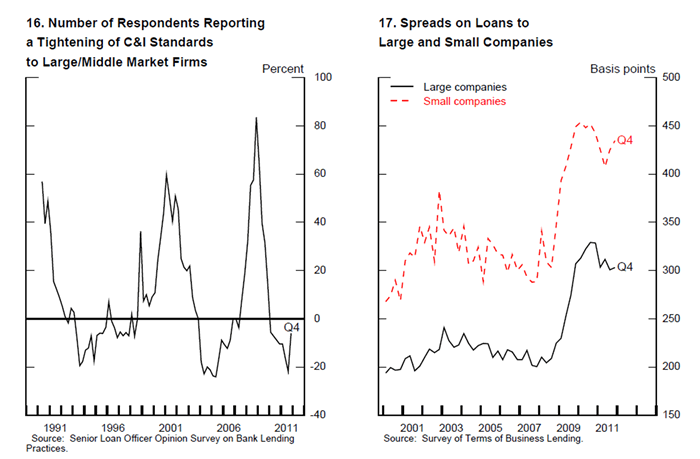



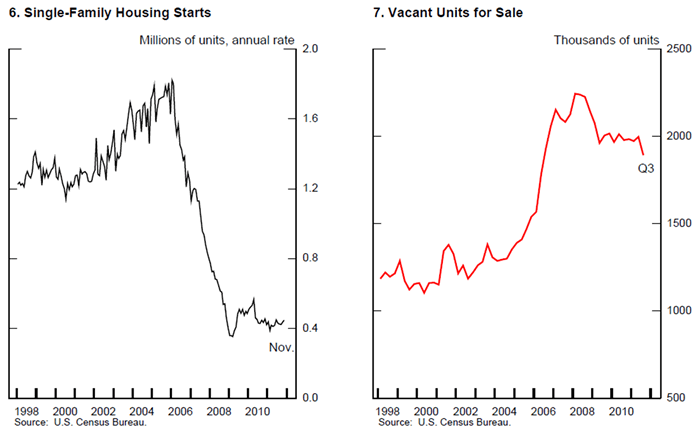
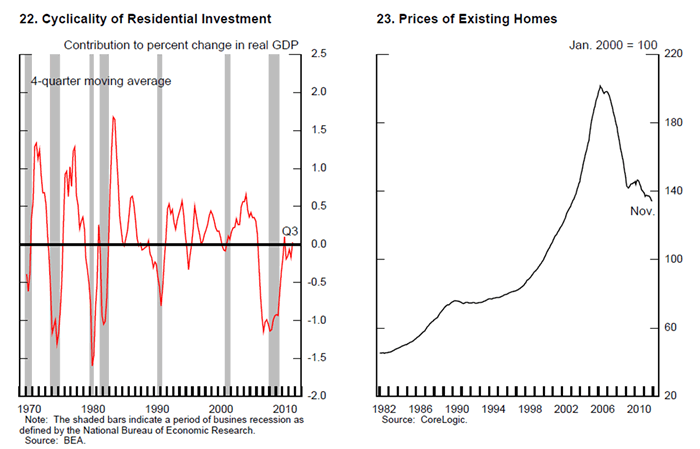
Back on U.S. shores, I want to focus the remainder of my discussion today on the housing and mortgage markets, which are so important for the economic recovery. As I alluded to earlier, and as I am sure you are all very well aware, housing markets have shown little sign of improvement so far in this recovery. This stands in sharp contrast to the important role that the housing sector has typically played in propelling economic recoveries (chart 22). During a downturn, reduced spending on durable goods--including housing--generates pent-up demand, which in itself helps sow the seeds of recovery. Once the cycle bottoms out, improving economic prospects and diminishing uncertainty usually help unleash this pent-up demand. This upward demand pressure is often augmented by lower interest rates, to which housing demand is typically quite responsive. Moreover, spillovers from increased housing demand--such as wealth effects from higher house prices, purchases of complementary goods such as furniture and appliances, as well as strengthening bank balance sheets--have, in the past, provided a powerful additional impetus to the recovery.

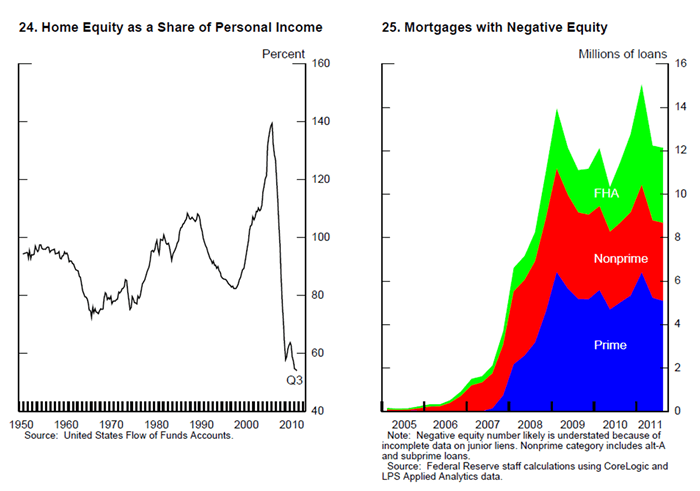

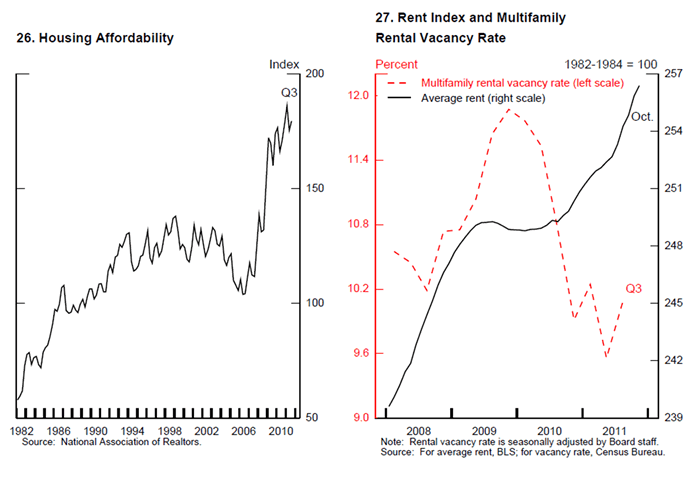

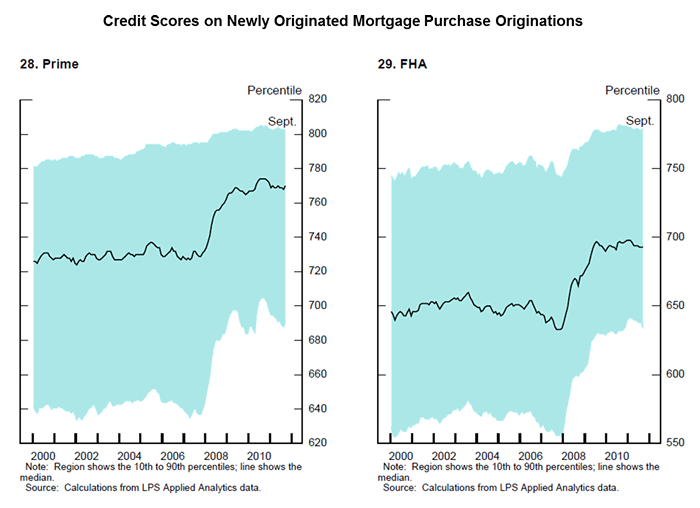

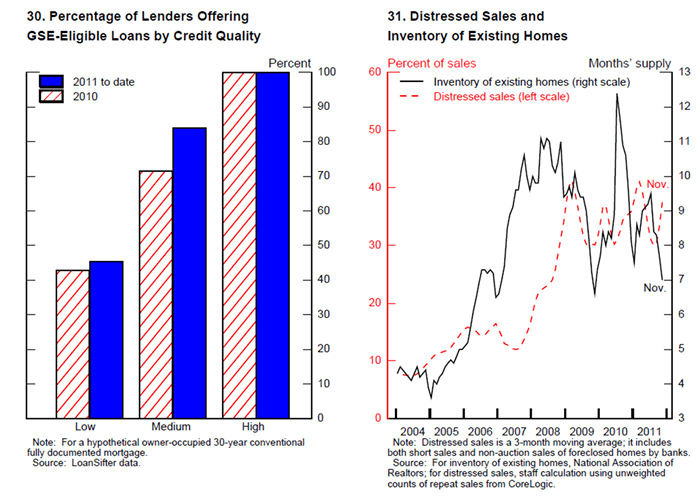

To sum up, I expect continued moderate recovery in 2012. My forecast is for the unemployment rate to gradually (and perhaps fitfully) move lower and for inflation to settle over coming quarters at or below levels consistent with the Federal Reserve's dual mandate. In this environment, I believe that the current stance of monetary policy is appropriate. However, the economic situation remains very uncertain, and I see considerable risks, on both the downside and the upside, to the forecast I've laid out here. While potential spillover from the situation in Europe certainly represents a downside risk to this forecast, I also believe that the steadily improving consumer debt picture represents an upside risk. And any acceleration in the repair of housing and mortgage markets could add even stronger momentum to recovery. As always, the FOMC will continue to assess the economic outlook in light of incoming information, and we are prepared to employ our tools as appropriate to foster economic recovery in a context of price stability.
Wednesday, January 4, 2012
Indian Service sector rebounds and roars
Tuesday, January 3, 2012
Reliance Industries foray into Infotel and TV 19, ETV
ETV Telugu News (“Telugu Channels”).